A tingling sensation that pervades the body, capable of transmitting pleasure, calm and relaxation, this is what ASMR is.
ASMR is the acronym used to indicate the Autonomous sensory meridian response (in Italian autonomous response of the sensory meridian) and that the writer has had the opportunity to experience firsthand. Many times, in fact, when faced with certain situations or behaviors, when I was very young I ended up falling into a sort of «trance».
During these brief but intense moments, I experienced a pleasant tingling sensation that started from the head and then gradually affected other parts of the body. It was inexplicable, but since it had a positive effect, especially pleasure and relaxation, I had no particular worries. Only much later did I discover that my case fell into the so-called ASMRin many cases also known as cerebral orgasm.
The great interest in ASMR
I always thought that what I felt was a characteristic of mine alone, as ineffable as it was irresistible. When I looked for feedback from other people, mostly peers, such as friends or classmates, it generally ended with great teasing. As a result, I decided to keep my secret all to myself.
Today, thanks to the diffusion and practically limitless communication offered by the web and social networks, I know that many other people in the world are affected by this cerebral orgasm. I discovered, then, that I am not the only one who experiences ASMR.
Its discovery has awakened an unpredictable interest among scholars and the population in general. More and more people are looking for information about ASMR, even though the causes are still unknown. In any case, I can assure you, there is nothing more heartening than finding other people with whom to share an anomalous situation. While being pleasant, as in this case. This is an unusual topic, about which science still has many doubts, but even just talking about it is therapeutic.
An example of this growing interest can be found on the internet. There are many YouTube videos dedicated to ASMR, hashtags, posts, blogs, articles, non-profit associations, podcasts, press releases, interviews and even academic publications. What we commonly know as cerebral orgasm is attracting the attention of public opinion and researchers as well as treatments for anxiety, for example, considered the evil of our century.
According to research carried out, ASMR is an intrinsic property of some people’s brains that it is used as a form of relaxation or to experience pleasant body sensations.
“ASMR is similar to the deep relaxation a person may feel when receiving a massage.”
-Prof. Craig Richard, Shenandoha University, Virginia-
ASMR: origin and meaning
As already mentioned, this term indicates an autonomous response of the sensory meridian. This response is triggered by specific visual or auditory stimuli.
Receiving attention from another person can also serve as a trigger, although it is less common. On the other hand, by analyzing the components of the acronym one by one, it is possible to decipher some factors that help to better define this phenomenon. To facilitate understanding of the concepts, we will not use the Anglo-Saxon acronym ASMR, but rather the Italian one, RAMS:
- Answer. It refers to an experience triggered by an internal or external agent.
- Autonomous. Spontaneous, free action, with or without control by the person.
- Meridian. It refers to the maximum point of climax (the aforementioned cerebral orgasm).
- Sensory. The phenomenon relating to the senses, to what they can perceive.
That inevitable tingling that causes relaxation
Let’s start by distinguishing sexual pleasure from that of ASMR, generally described as “a tingling that originates in the neck and pervades the body, like a wave of pulsing tickles.”
In an article published in the prestigious The New Yorkerit is possible to read the definition according to which ASMR «arises from the reassuring sound of the whisper of a voice or the sweet contact of clothes; it is a tingling sensation that extends from the back of the neck, up to the shoulders and reaches the arms, accompanied by a profound state of calm, or even euphoria.»
The two pleasures, sexual pleasure and ASMR, are different both by nature (structures and physiological processes involved), and by the final result (ASMR does not culminate in a true orgasm), and the purpose (ASMR does not pursue the satisfaction of a sexual drive). Sexual arousal and ASMR arousal have been shown to be, in general, mutually exclusive.
Some examples of ASMR
For those who have never tried it, it is difficult to understand what it is. To help you, we will list some examples. From a perceptual-sensory perspective, some describe this sensation as a pleasant and relaxing «light electric shock».
In my personal case, I consider it more similar to the effect of sparkling wine bubbles. But, obviously, each person affected will experience this sensation in a subjective way.
Here are some factors that can trigger this autonomous response of the sensory meridian:
- Hearing a voice whisper or speak softly.
- Listening to light and repetitive sounds, the result of daily activities (such as leafing through a book).
- Carefully observe someone performing a mundane task.
- Receive personalized, attentive attention.
- Observe a person chewing food or drinkingmaking loud noises.
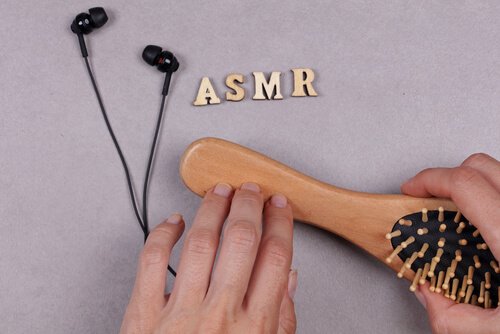
- Listen to a repetitive clicking sound (such as nails on plastic, wood, and metal surfaces).
- Etc.
Clinical applications of ASMR
The use of the ASMR induction technique is not recognized by any official body as a valid therapeutic measure. Therefore, it cannot be recommended as a substitute for any approach or treatment.
However, more and more people are using ASMR-based approaches to treat specific problems related to the anxiety spectrum (generalized anxiety, panic attacks, difficulty concentrating, ruminative thinking or difficulty falling asleep, among others).
The therapeutic effect of this phenomenon would resemble the form and action of extended techniques such as meditation, yoga or full awareness.
According to science, the psychophysiological state of relaxation and well-being is determined by various factors such as blood pressure, the release of endorphins or changes in heart rate.
Possible explanations
There is little objective and replicable data that testifies to the origin and operating mechanisms of this phenomenon. There has been talk, however, of a relationship between people sensitive to ASMR and the likelihood of misophonia (annoyance towards certain noises, particularly those caused by people). It is therefore believed that there may be a genetic basis to explain this phenomenon.
In functional magnetic resonance imaging (MRF) studies, it was observed that in subjects “tickled” by ASMR, brain areas associated with social behaviors of interpersonal control or approach (in the medial prefrontal cortex) and tactile sensations (in the secondary somatosensory cortex) exhibited unusual activity. This activation was also much higher than that presented in control subjects or in times of absence of ASMR.
The truth is that all those who are lucky enough to enjoy this natural, simple, innate and uncontrollable mechanism are not too interested in understanding its origins nor its functionality. It’s an extremely pleasant experience and that’s what matters.
Latest Posts Published
Head massage: 5 unsuspected benefits
How to overcome anxiety and gain self-confidence
What does sophrology treat? | Discover its advantages and how it can help you?
Acupressure: Acupuncture without needles
Managing negative emotions in 6 steps
How to monitor your sleep quality: apps and devices
8 sophrology exercises to overcome stress
Foot reflexology in Castelginest: relaxation near Toulouse
Positive Attitude: 7 Key Steps to Reduce Stres