Do you know ASMR? The acronym ASMR stands for «autonomous sensory meridian response» and could be translated as autonomous sensory meridian response. ASMR videos are very popular on YouTube, especially among people suffering from stress or insomnia who experience a physical sensation of well-being in response to certain sensory stimuli. What are these effects? Are we all sensitive to them? Find out everything you need to know about this Internet phenomenon.
What is ASMR?
The practice first appeared on YouTube in the United States in 2010. ASMR is an experience characterized by a static or tingling sensation on the skin that usually starts at the scalp and runs down the back of the neck to the spine. Only those who are sensitive to it can truly understand it. Indeed, we are not all the same when it comes to ASMR. For some it gives a pleasant feeling of relaxation. For others it is unbearable.
ASMR is usually activated by stimuli called “triggers”. ASMR triggers, typically auditory and visual, can be found in interpersonal interactions in everyday life. Additionally, ASMR is often triggered by exposure to specific audio and video data. That’s why ASMR enthusiasts encourage newcomers to find out what their triggers are. In fact, on the Internet you can mostly find videos that offer auditory triggers: whispers, crumpled papers, blows… And videos that offer visual triggers, such as caresses, candles, oil lamps, etc. or even textures like kinetic sand, mad matt’r and others.
Different ASMR practices
Emma Barratt and Nick Daviespsychologists at Swansea University (UK) were the first to analyze in 2015 what motivated people to watch this type of video. Discover the answers to the study:
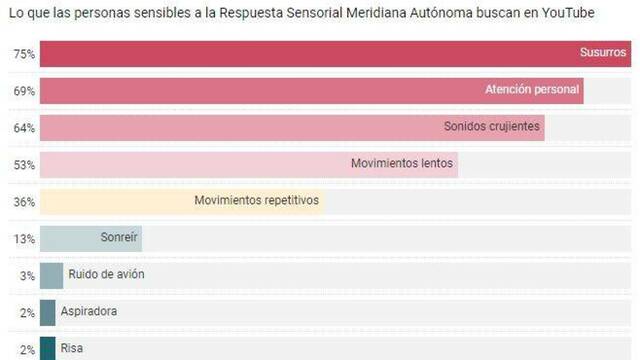
Source: https://www.elconfidencial.com/tecnologia/ciencia/2018-08-28/asmr-enfermedad-sensorial-misofonia-youtube_1608574/
There are several stimuli that can trigger ASMR. Each person must find out if they are sensitive to ASMR and therefore what the triggers are. The words used to describe the different types of ASMR videos are usually in English. Don’t panic, here are some explanations that will help you orient yourself.
Auditory ASMR:
AND type of ASMR It is induced by some type of auditory stimulus, either through whispering or by making rhythmic or repetitive sounds such as writing or rubbing your hands on certain objects.
- Widely used in ASMR videos, tapping involves making small noises by touching objects with your fingers or nails.
- «Whispering» means hearing a soft, whispering voice.
- Some people prefer «scratching», which involves scratching an object near the microphone.
- Others enjoy listening to the quiet, repetitive sounds of someone performing a mundane task, such as turning the pages of a book.
- Loudly chewing, munching, drinking, or biting food, drinks, or gum are also ASMR triggers. As for the sweets, these videos have a name also borrowed from the English «eating candy».
- «Brushing» involves stroking the microphone with an object that has bristles, such as a toothbrush, makeup brush, hairbrush, etc.
- “Crinkling” refers to ASMR videos where paper is crumpled, presents are opened, etc.
Auditory and visual ASMR:
- Watch someone carefully perform a common task, such as preparing food.
- “Hand motions” are videos of slow hand movements directed towards the camera as if they are touching you, accompanied by sounds or whispers.
- “Role-playing” in ASMR is a fiction in which the YouTuber plays the role of someone who will take care of you, such as a health or beauty professional: hairdresser, makeup artist, etc.
What are the therapeutic impacts?
Finally, ASMR is a self-stimulation tool used by some people to self-regulate and lower blood pressure. So could ASMR be useful specifically for people with specific sensory needs? There are few studies on the therapeutic impact of ASMR. Therefore, further research is needed. However, there appears to be a positive impact for some people, such as those with anxiety, those on the autism spectrum, and those with Alzheimer’s disease.
ASMR and mental health
In addition to being a pleasant sensation, many people who watch ASMR videos say it helps them reduce symptoms of depression, anxiety and insomnia. Recent research1 suggests that these claims are plausible. In a controlled experiment, people sensitive to ASMR watched these videos and reported feeling much calmer. His heart rate actually dropped.
The effect is comparable to that resulting from mindfulness exercises recommended by some psychologists, in which patients are encouraged to accept emotions rather than repress them.
ASMR and autism
An American study2 examined this question and found that the therapeutic use of ASMR videos improved the mood and behavioral development of people with ASD. ASMR, in fact, allows them to benefit from calming sensations. Its use as audiovisual therapy can be part of an early intervention protocol, alleviating symptoms associated with seizures and difficulties with emotional self-regulation.
The accessibility of this type of technique is an important factor to consider, as are previous evaluations for misophonia3 and other potential factors that may limit the benefits of ASMR. Creating an app with readily available ASMR videos can allow for quick access when needed. Advancing ASMR through further research has the potential to benefit the autism community with its wide range of possibilities. Therefore, ASMR could be promoted in the self-care of people diagnosed with ASD.
Check out this ASMR YouTube channel for people with autism:
ASMR and Alzheimer’s
Professionals who care for people with Alzheimer’s and dementia often note that music seems to lift people out of the confusion and fog of the disease and bring them back (even temporarily) to normalcy. This phenomenon has been observed many times, but has only recently been studied.
According to the Journal of Prevention of Alzheimer’s Disease, the part of the brain responsible for ASMR is not damaged by Alzheimer’s disease.
Dr. Jeff Anderson, an associate professor of radiology at University of Utah Health and an author of the study, says he was surprised by the physical findings. Alzheimer’s disease and dementia gradually attack the entire brain, but not this specific area. More research is needed to find out why. Meanwhile, this information is already used by those who care for dementia patients.
«No one says listening to music will cure Alzheimer’s disease,» warns Dr. Anderson, «but it could make symptomsmore bearable, reduce treatment costs and improve the patient’s quality of life.»
Latest Posts Published
Head massage: 5 unsuspected benefits
How to overcome anxiety and gain self-confidence
What does sophrology treat? | Discover its advantages and how it can help you?
Acupressure: Acupuncture without needles
Managing negative emotions in 6 steps
How to monitor your sleep quality: apps and devices
8 sophrology exercises to overcome stress
Foot reflexology in Castelginest: relaxation near Toulouse
Positive Attitude: 7 Key Steps to Reduce Stres