
What is Usui Reiki?
Usui Reiki is an energy healing method of Japanese origin, founded in the early 1920s by Dr. Mikao Usui (1865-1926), a Japanese monk searching for spiritual healing methods. He has developed a practice of laying on of hands that channels universal life energy (“Reiki”) to rebalance the body and mind. The Usui Reiki approach wants to be accessible to everyone, without requiring any particular belief and offers a complete cure that works on physical, emotional, mental and spiritual levels.
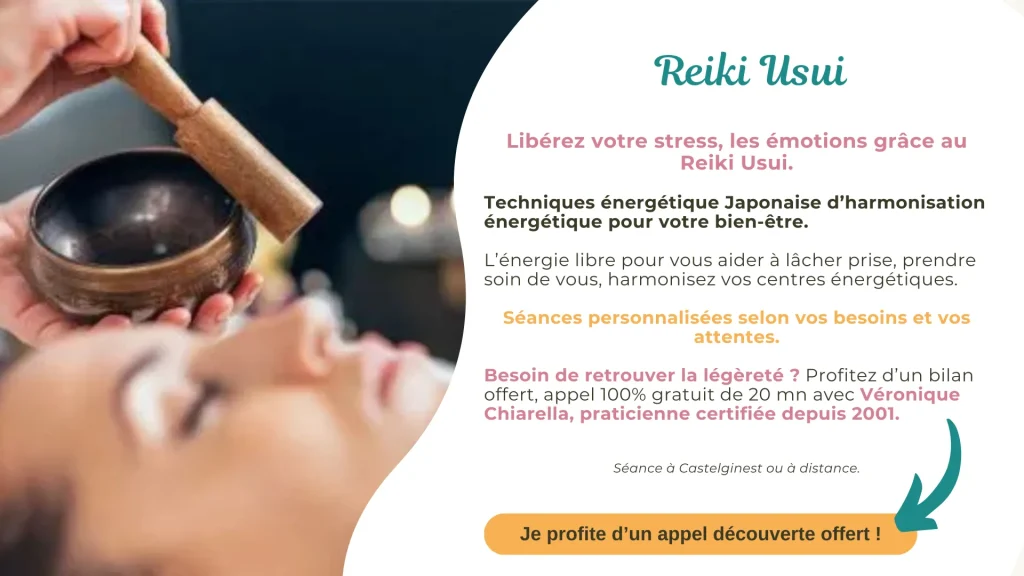
Usui Reiki is often sought after relieve pain, strengthen the immune system and help overcome trauma and emotional blocks. By promoting energetic harmonization, it supports the personal development and spiritual evolution of each individual, accompanying the individual in the search for inner peace.

The benefits of Reiki
Thanks to its ability to release tension and activate natural self-healing processes, Usui Reiki can provide a multitude of benefits, including:
- Soothes physical pain
- Renewal of vital energy
- Significant reduction in stress
- Release of emotional blocks and old traumas
- Reduction of anxieties and limitation of fears
- Improved self-confidence and concentration
- Spiritual support for better understanding of life events
These effects are uniquely experienced by each recipient and may vary depending on individual mood and needs.
How to prepare for an energy harmonization session?
Although Reiki does not require special training, some simple practices can maximize its benefits. It is best not to eat immediately before the session so that the body can fully accommodate the energy. It is also recommended to turn off your phone, relax and release any previous tension to promote a deep and pleasant experience.
Progress of a Usui Reiki session
The Usui Reiki session follows precise steps to offer a personalized and comfortable treatment:
- Welcome interview
Before starting, the practitioner takes a moment to speak with the recipient. This exchange allows us to present Reiki, to clarify the flow of the session and to identify together specific expectations and areas of tension. - Installation on the treatment table
The recipient remains dressed and lies comfortably on a massage table. To facilitate relaxation, she removes her shoes, jewelry and belt. A soft blanket can be used to add comfort and allow the recipient to fully relax. - Laying on of hands
The treatment consists of a series of laying on of hands on different parts of the body, each position lasting several minutes. The practitioner follows an energetic path and can focus more on some specific areas or chakras depending on the person’s needs. The hands can convey sensations of warmth, tingling or a sensation of energetic circulation. - End of the session and final exchange
At the end of the treatment, a period of rest is offered to allow the recipient to anchor themselves to their feelings. Therefore, an exchange between professional and recipient allows you to share impressions and ask any questions.
Feelings during and after a Reiki session
During the session it is normal to feel a pleasant warmth, tingling or deep relaxation. Each person reacts differently and the effects may vary from session to session. After the session, the recipient will be able to feel lightness, a feeling of well-being and general calm.
In some cases, Reiki can cause a self-healing response, which may include headaches, temporary tiredness, or other signs of eliminating toxins. These symptoms generally disappear within 24 hours. To aid elimination, it is recommended to drink plenty of water and practice breathing exercises or light meditation.
After the session: reinforce the benefits of Reiki
To prolong the beneficial effects of Reiki, relaxation, breathing or meditation exercises are recommended. These simple practices help to anchor the positive energy received during treatment and allow you to continue on the path to well-being.
Frequency of Usui Reiki sessions
If a single Reiki session can already bring great relaxation and a feeling of well-being, a deeper treatment of chronic disorders or old blockages may require multiple sessions (3 to 5) close together. Therefore, a more spaced pace is often sufficient to maintain this balance, depending on the needs of the recipient. A one-off anti-stress session is also useful for maintaining general relaxation.
Who can benefit from Usui Reiki?
Reiki is for all ages and requires no beliefs or prerequisites. Animals can also benefit from this energetic treatment, as it is delicate and caring. Usui Reiki can be an effective adjunct for anyone seeking energetic support alongside medical care, although it does not replace traditional medical care.
the invitation to harmony
Usui Reiki is much more than an energy treatment; it is an invitation to serenity, self-knowledge and profound healing. Everyone can find peace, mental clarity, and emotional freedom to move forward with confidence and kindness in their daily lives. For any questions or to organize a session, I remain available to guide you through this unique experience.
Did you like this article? Follow me on Instagram for more tips! 💃🏻
Latest Posts Published
Head massage: 5 unsuspected benefits
How to overcome anxiety and gain self-confidence
What does sophrology treat? | Discover its advantages and how it can help you?
Acupressure: Acupuncture without needles
Managing negative emotions in 6 steps
How to monitor your sleep quality: apps and devices
8 sophrology exercises to overcome stress
Foot reflexology in Castelginest: relaxation near Toulouse
Positive Attitude: 7 Key Steps to Reduce Stres