
In the daily whirlwind of life, managing emotions emerges as a constant challenge. The ability to successfully navigate emotional ups and downs is essential to cultivating lasting mental well-being. In this article we will explore the key stages of managing emotions, with a particular focus on sophrology as a powerful tool to balance mind, body and soul.
Step 1: Recognize an emotion pleasant or unpleasant
The crucial first step to effective emotional management is emotion recognition. Take the time to connect with your feelings, identify the emotions present and give them the necessary attention. This conscious act forms the basis of the entire process.
Step 2: Embrace the emotion negative
The key is gentle acceptance of emotions. This step involves fully and without judgment accepting the emotions that arise. Practicing mindfulness is an essential tool at this stage, as it allows you to stay grounded in the present moment.
Step 3: Understand the message of the emotion
Every emotion carries with it a precious message. Sophrology, with its relaxation and body awareness techniques, can help explore these profound messages. Whether it’s unmet needs, recurring patterns, or past interactions, understanding the message strengthens your connection to yourself.
Step 4: Managethe emotions
Learning to manage emotions is a central aspect of emotional management. Techniques like conscious breathingmeditation and visualization can be integrated to develop personalized stress management strategies. Sophrology offers a holistic approach, involving the body and mind in this process.
Step 5: Know the tools to improve your emotions harmful
Exploring various methods is key to finding what resonates best with you. Sophrology, with its comprehensive approach that includes relaxation, controlled breathing and positive visualization, stands out as a versatile tool for improving one’s emotions and promoting a balanced life.
Step 6: Stop the emotional roller coaster
The term “emotional rollercoaster” refers to intense fluctuations in emotions. Learning to stop them requires a deep understanding of yourself. Sophrology, by strengthening emotional coherence, offers tools to interrupt this cycle and maintain a lasting emotional balance.
Sophrology: A holistic approach to managing emotions
At the heart of emotion management, sophrology presents itself as a holistic and effective approach. Its principles include physical relaxation, controlled breathing, positive visualization and body awareness. Practicing sophrology regularly can have significant benefits for emotional stability.
Understanding the difference between emotions and feelings:
There is a subtle nuance between emotions and feelings. While emotions are instantaneous responses, feelings are lasting responses. Understanding this distinction, explored in detail in this article, allows us to better navigate the complex world of our emotional reactions.
Embracing an emotion:
Embracing an emotion takes practice and kindness towards yourself. Practical tips, such as mindfulness, emotion identification, and emotional expression, are provided to guide you through this crucial step.
Understanding the message:
Each emotion carries with it a message that can be deciphered by identifying underlying thoughts and exploring unmet needs. This detailed understanding contributes to more effective emotional management.
Observe: Take the time to observe yourself. Pay attention to the physical signs (such as muscle tension, rapid breathing) and the thoughts that cross your mind.
Naming emotions: Identify and name the emotion you feel. For example, are you angry, sad, happy, anxious, etc.?
Identify triggers: Try to understand what triggered this emotion. Is it a specific situation, a thought, or an interaction with someone?
Explore the thoughts below: Examine the underlying thoughts and beliefs that may be contributing to this emotion. For example, if you feel anxious, ask yourself if there are irrational thoughts associated with that anxiety.
Acceptance: Accept your emotions without judging them. It’s normal to feel a range of emotions, and they can often be important indicators of what’s happening in your life.
Learn to manage emotions even if they are uncomfortable:
Dealing with unpleasant emotions is an essential aspect of emotional management. Practical strategies, how cardiac coherencethe acceptance of discomfort and the use of calming mantras, the best known of which is «Om», but there are others equally powerful and interesting such as «So Hum», or even Shanti (Shan Tee), etc. I regularly provide relaxation sessions associated with sound, with mantras, the results are impressive!
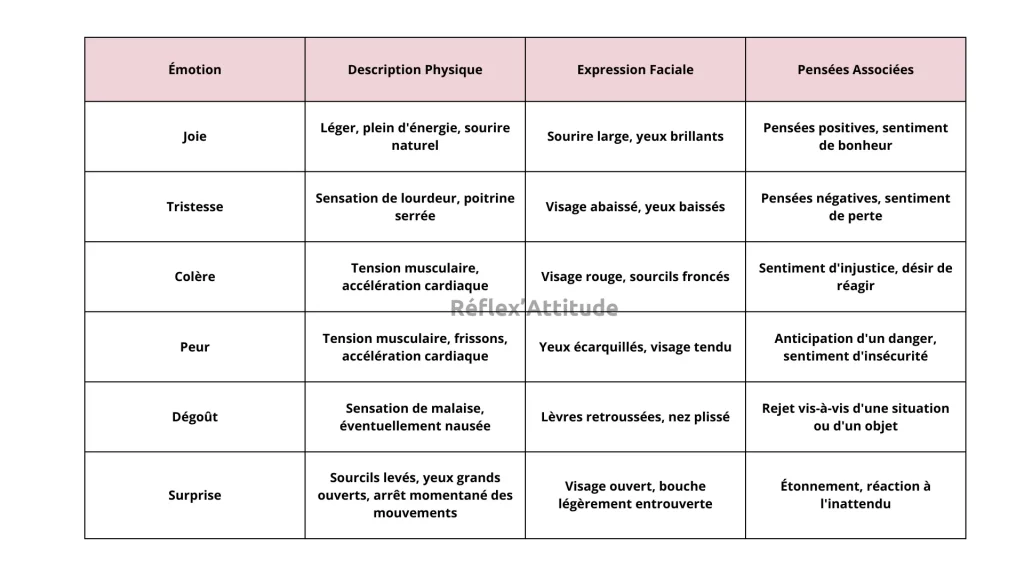
Emotion graph
Here is a table that illustrates some emotions, allowing us to better understand and recognize these emotional states 😉
Impact of emotions on well-being hormones
Emotions are not just mental experiences; they have a physical impact on our body. One way this happens is through the influence of hormones, the body’s chemical messengers. Some hormones, often influenced by emotions, play a crucial role in well-being. An emotion is a message if you don’t describe it, if you repress the emotion, we don’t say “Everything that is not expressed is printed”. A repressed emotion can over time become anchored in a part of the body and cause pain or even lead to burnout, when the body no longer follows your mind, the body will say «No! «, » Stop » !
Here is a table illustrating some of the main feel-good hormones and their relationship with our emotions 👇🏻
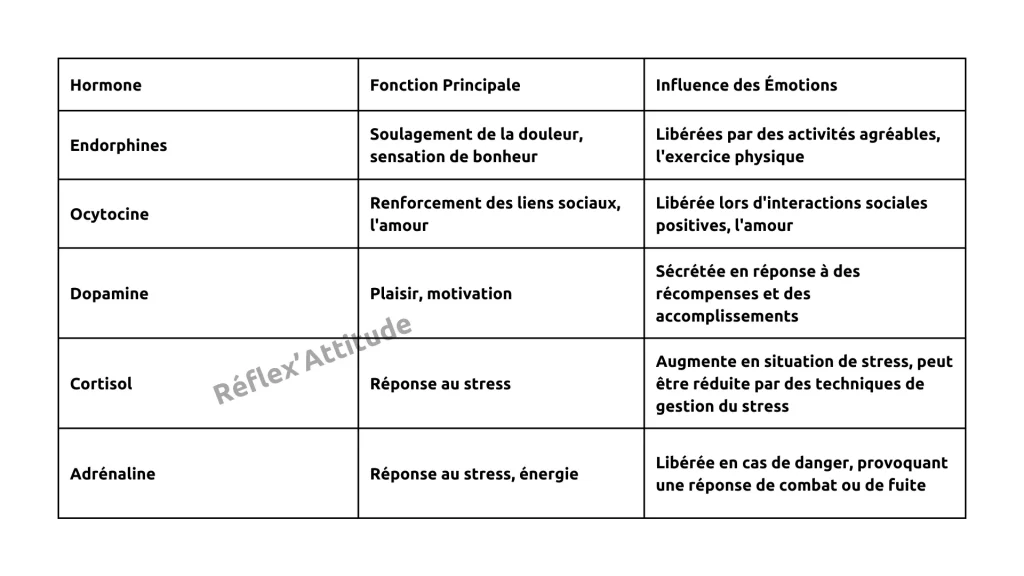
By understanding the impact of emotions on these hormones, it becomes possible to adopt strategies to encourage the release of beneficial hormones and thus promote emotional and physical well-being. This insight highlights the positive impact of emotions on our overall well-being. It highlights the importance of cultivating positive emotions, as I often say, it takes a lot of positivity! Because positive slides like Teflon and negative sticks like Velcro! (Discover positive psychology coaching exercises)
Why stop the emotional roller coaster?
The benefits of stabilizing the emotional roller coaster are numerous. From improving mental well-being to emotional coherence, this article explores why working on emotional stability is a valuable investment in your balance and quality of life.
Managing emotions is an ongoing journey, and sophrology positions itself as a valuable companion in this exploration. By cultivating a regular practice, integrating various tools such as a low glycemic index diet, sport, relaxation, massage and deeply understanding emotional mechanisms, it is possible to develop a lasting ability to control your emotions and live a fulfilling life.
Integrate essential oils and Bach flowers in managing emotions:
Essential oils and Bach Flower Remedies are two natural options that have gained popularity. Essential oils, such as true lavender for relaxation or lemon for energy, can be used througharomatherapy.
Bach flowers, like Rescue Remedy, are floral elixirs renowned for their ability to balance emotions by absorbing all the benefits and positive messages of plants and flowers.
Example of a sophrology exercise with an essential oil (EO):
Take 10 minutes for yourself, sit in a quiet place where you won’t be disturbed, turn off your cell phone.
- Choose an essential oil known for its calming properties, such as real lavender.
- Find a quiet place to sit comfortably.
- Close your eyes and begin to breathe deeply, focusing on your breathing.
- Apply a drop of lavender essential oil to the inside of your wrists.
- Continue breathing deeply as you slowly inhale the scent of the oil.
- Visualize a quiet place, such as a flower garden. Visualize a resource location you know or a completely imaginary location.
- With each exhalation, release the tension and imagine the scent of lavender gently enveloping your thoughts.
- Remain in this calm state for a few minutes, then slowly open your eyes.
This simple exercise combines sophrology with the benefits of essential oils to promote relaxation and emotional balance. Using essential oils in the sense of smell there are much fewer risks than using essential oils in massage or otherwise without prior advice from a certified professional, in the context of the article real lavender is very safe, carefully follow the instructions for use and storage on the product packaging.
Did you like this article? 🤩
To conclude this overview on managing emotions, I invite you to join me on my YouTube channel, where I share free meditations, guided relaxations to help you.
Latest Posts Published
Head massage: 5 unsuspected benefits
How to overcome anxiety and gain self-confidence
What does sophrology treat? | Discover its advantages and how it can help you?
Acupressure: Acupuncture without needles
Managing negative emotions in 6 steps
How to monitor your sleep quality: apps and devices
8 sophrology exercises to overcome stress
Foot reflexology in Castelginest: relaxation near Toulouse
Positive Attitude: 7 Key Steps to Reduce Stres