
Surely you already know what are those «basic» things to follow to prevent the appearance of wrinkles and have a healthy complexion: avoid exposure to the sun, use SPF cream daily, follow an adequate skincare routine, don’t smoke and eat healthily.
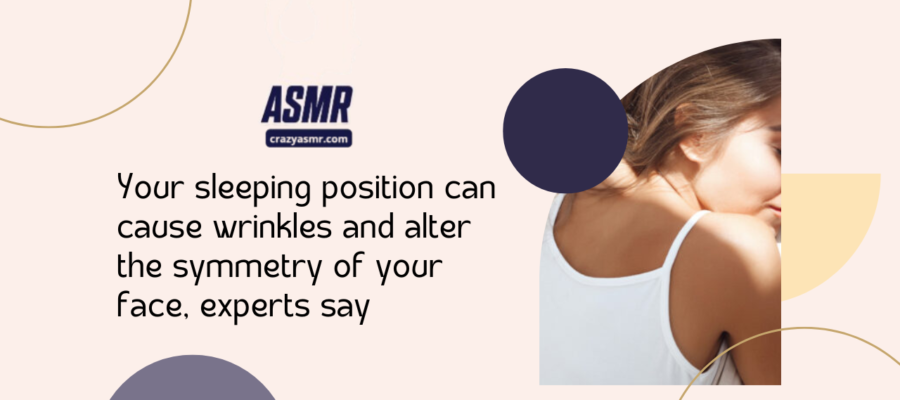
But there’s something you do unconsciously that could be causing deep wrinkles or even affecting the symmetry of your face: it’s about your sleeping position.
This topic has become increasingly popular on social networks and has sparked numerous discussions. In a video posted on TikTok that went viral, a beauty influencer from the United States named Marianne claimed that the irregular shape of her lips was caused by the fact that she sleeps on her side.
The post has been viewed more than 15 million times and has nearly 7,000 comments.
Is it possible that the position you sleep in affects the symmetry of your face? And could it really cause wrinkles?
Unfortunately, as far as wrinkles are concerned, the answer is positive. But when it comes to the symmetry and shape of the face, the opinions of specialists cited by the Daily Mail are divided.
Kate Kerr, beautician and founder of the Kate Kerr London Clinic, is convinced that the way you sleep has a significant impact on both your face and décolleté.
«According to a study published in the Aesthetic Surgery Journal, the forces of compression, tension and pressure exerted on our face during sleep can lead to facial distortions,» says the specialist.
“Such distortion manifests itself as vertical folds and folds that form when we sleep on our side or stomach,” he adds.
These creases may initially be temporary, caused by sleep, and appear along lines that extend from the nose to the corners of the mouth. But over time, as the skin ages and loses its natural elasticity and ability to return to its original shape, the creases can become permanent.
The same goes for the body, when gravity intervenes. “When we’re on our side, our breasts can sag, forming visible vertical lines in the décolleté area,” says Kate.
No one is born with a perfectly symmetrical face, but fortunately, says the specialist, the risk of greater facial asymmetry due to sleeping position is quite small. “It is unlikely to have a significant impact on the symmetry of the eyes and lips,” says Kate Kerr.
Sleep position plays a role in facial asymmetry
On the other hand, plastic surgeon Maryam Zamani believes that sleeping position plays a role in facial asymmetry.
“Sleeping on your side leads to repetitive pressure on a certain area, which creates folds and accentuates wrinkles and lines on the side you sleep on. This accentuates the asymmetry of the eyes, lips and face,” says Dr. Zamani.
And this may mean that one eye will have a slightly different shape or a droopy eyelid, or that one corner of the mouth may appear lower than the other.
“As we age, asymmetry becomes more and more visible and, in addition, the skin’s elasticity decreases, which means that it takes longer for facial lines and folds to disappear after a night’s sleep,” adds the expert.
While sleeping on your side has negative effects, experts warn that sleeping on your stomach is even more harmful.
«Sleeping on your stomach is considered the unhealthiest sleeping position for skin health,» dermatologist Dianni Dai tells Mail Online.
«The face is pressed against the pillow, which causes wrinkles and acne. The same applies to the décolleté area, which is affected in the same way due to friction with the pillow and sheets,» adds the specialist.
He says the best sleeping position for your skin is to sleep on your back.
“When you sleep on your back, there is obviously no friction on your face. And at the same time, it allows for better blood circulation, which prevents fluid from accumulating on your face and reduces the risk of facial swelling and dark circles or bags under your eyes,” says Dr. Dai.
What can you do if you sleep on your side or stomach?
Obviously the answer is to sleep on your back, but it’s not as simple as it seems.
“When we sit in bed, we can consciously choose the position we want to rest in, but after we fall asleep we no longer have control and can change position on average about 20 times a night,” says Kate Kerr.
One possibility, explains the specialist, is to use a neck pillow or travel pillow for a few days.
«It prevents you from turning on your side and you will gradually get used to sleeping on your back,» says the specialist.
Dr. Dai recommends gradually transitioning to a new sleeping position if you prefer to sleep on your stomach: «Start by using a thinner pillow to reduce pressure on your neck, and sleep on your side with a supportive pillow.» You can then gradually transition to sleeping on your back.
Additionally, some people are unable to sleep on their backs due to medical problems, such as sleep apnea. If you experience problems of this type, the specialist recommends sleeping on the opposite side to the one you normally prefer. After falling asleep, you will return to your favorite part, but give it a short break, to restore balance, the doctor says.
Photo: freepik.com
Latest Posts Published
Head massage: 5 unsuspected benefits
How to overcome anxiety and gain self-confidence

What does sophrology treat? | Discover its advantages and how it can help you?
Acupressure: Acupuncture without needles
Managing negative emotions in 6 steps
How to monitor your sleep quality: apps and devices
8 sophrology exercises to overcome stress
Foot reflexology in Castelginest: relaxation near Toulouse
Positive Attitude: 7 Key Steps to Reduce Stres